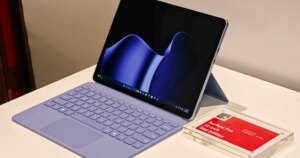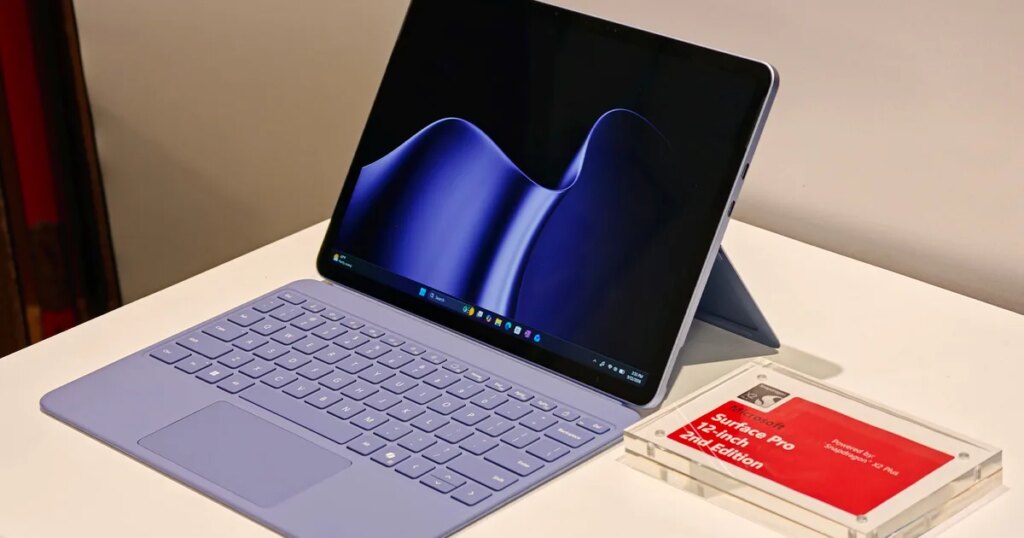
Qualcomm took us to Maui for the Snapdragon Summit, but the Microsoft Surface showcase on the show floor quickly became less about specs and more about what these new Snapdragon-powered machines can actually do.
The demos ranged from small interface touches to surprisingly demanding creative workloads, offering a glimpse into how Microsoft sees local AI evolving on Windows PCs. And some of it was much more impressive in person than it looked on paper.
Haptics make Surface more connected
The first demo was also the easiest to ignore: haptic feedback. Microsoft showed how haptic feedback is integrated into the Surface touchpad and pen, with demonstrations in apps including Affinity, DaVinci Resolve and PowerPoint. Align an object, snap something into place, scroll through a timeline, or make certain mistakes, and the device responds with a tiny physical pulse.
It seems like a small feature. It doesn’t seem like one.
The closest comparison is the tactile sensation of the smartphone. Vibration feedback was once something users barely noticed, but eventually good tactile feel became part of what made a premium smartphone refined. Microsoft’s implementation on Surface creates a similar physical bridge between an action and its result. The interesting part is that the value becomes clearer when you return to the trackpad or conventional pen.
Of course, it won’t make a laptop faster, but it will make interacting with one more deliberate. And for creative applications, where users are constantly moving, aligning, selecting, and manipulating objects, that extra level of feedback could become surprisingly useful.
Your phone has just become part of your PC
Microsoft also showed off a more subtle feature that could prove to be one of its most useful: deeper integration between Phone Link, an Android phone, and the Copilot CLI.
In the demo, a Nothing Phone was connected to the Surface laptop, after which the user could interact with files on the phone from the PC using natural language. Instead of manually opening the Gallery, searching through hundreds of images, and copying them, the user simply asked Copilot CLI to find suitable images from the phone’s gallery for a social media post.
The AI searched through the available files, analyzed the images, identified the relevant ones, and copied them to a new folder on Surface. Microsoft already supports accessing and transferring Android photos and files via Phone Link, but this demo showed what happens when an AI agent becomes the interface for that workflow.
What made the demo particularly interesting was how little the user actually had to do. There was no timely processing and no file searches. The instruction was essentially a regular sentence, with Copilot handling the steps underneath. Microsoft is clearly pushing towards a model where the PC understands the task rather than simply waiting for the user to use individual applications.
The best part for me was that the demo tied perfectly into Microsoft’s larger push for on-device AI. The phone provided the data, the Snapdragon-powered Surface did the heavy lifting locally, and the AI silently took care of all the tedious steps in between.
Snapdragon X2 Elite gets a proper creative workout
The biggest show was a creative workflow that traditionally would have required considerably more powerful hardware.
A Microsoft 3D artist started with a soccer ball drawn manually in Photoshop. That 2D concept was then brought into Blender, where AI helped transform it into a 3D asset. The artist could manipulate the model, resize it, add elements and then bring it back into Photoshop to work with light and shadow, while also introducing animations and camera movements.
The important thing wasn’t simply that Blender was running. The entire workflow remained responsive while the Surface convertible ran on battery power. The demo then moved on to generative AI. The final result was fed into an image generation workflow to create a more realistic football stadium scene, complete with lighting and environmental effects. From there, Microsoft showed a short video generated from the concept, turning what started as a rough sketch into a moving, cinematic-style scene.
Now, of course, none of these individual AI tricks are particularly new anymore. What was interesting was seeing them chained together on a 2-in-1 laptop. And this is where the NPU story becomes much easier to understand. Microsoft’s new Snapdragon X2 Surface machines are designed to handle AI workloads locally where possible, with the NPU taking on workloads that would otherwise fall to the CPU or GPU. The new X2 Plus models announced at Snapdragon Summit offer an NPU capable of up to 80 TOPS, while Microsoft’s broader X2 lineup also includes more powerful Elite configurations.
The demo also made an important point about the difference between theoretical AI performance and practical use. No one looking at it needed to know how many TOPS the processor had. The more useful question was simply: can it actually do the job? In this case the answer seemed to be yes.
Ink Canvas makes AI feel like less of a homework assignment
Microsoft’s Ink Canvas demo was perhaps the most interesting from a usability perspective.
Instead of opening a chatbot and figuring out exactly how to describe an idea, Ink Canvas starts with something much more natural: a blank visual canvas. Users can add images, scribble notes with a pen, highlight things, and organize items into a mood board.
The smart part is what happens next. A user can use the lasso tool to select specific parts of the canvas and ask the AI to work with that context. The same approach can be used to generate images or create textual summaries from material on the board.
This eliminates one of the biggest annoyances of generative AI: having to translate a visual idea into a very specific text message. Do you want to move a particular object? Draw where it should go. Do you want to explain what matters in an image? Circle it. Do you want to build a visual concept? Put the pieces together first and let the AI figure out the next step.
Microsoft says Ink Canvas will come pre-installed on supported touch-enabled Surface devices. The Canvas experience can work with local device features, while generative features require connectivity and a Microsoft 365 subscription.
But can Snapdragon really compete with Nvidia?
I also asked one of Microsoft’s designers how the Snapdragon X2 Elite compares to Nvidia’s RTX Spark platform, especially considering Microsoft’s push for much more powerful local AI hardware.
The response was quite pragmatic. Nvidia has the clear advantage in compute power and memory, which becomes increasingly important when running larger models or juggling several demanding workloads at once. RTX Spark is effectively aimed at a different class of machine, with configurations that offer massive memory capacity and substantially more AI computing.
Snapdragon is trying to provide enough graphics capabilities and local AI in a machine that can still be thin, convertible, and battery-powered.
But the conversation didn’t frame Snapdragon simply as “AI for mainstream users.” The designer’s point of view was that a professional creator can absolutely produce meaningful creative work on an X2 Elite Surface. The demo itself made this argument quite convincingly. The difference is really about the ceiling. Nvidia’s hardware gives creators substantially more headroom when workloads get extreme, while Snapdragon is trying to provide enough local AI and graphics capabilities in a machine that can still be thin, convertible, and battery-powered.
This distinction is perhaps the most interesting aspect of Microsoft’s demos. The future of AI PCs may not be about finding one chip that does everything. Instead, it could be about making increasingly powerful AI available at every level, from workstation-class machines built around massive amounts of memory and processing to Surface devices that can silently execute surprisingly sophisticated creative workflows while sitting in a coffee shop.