Want to bookmark your favorite articles and stories to read or refer to later? Start your independent membership today.
Sign up today
Already a member? Login
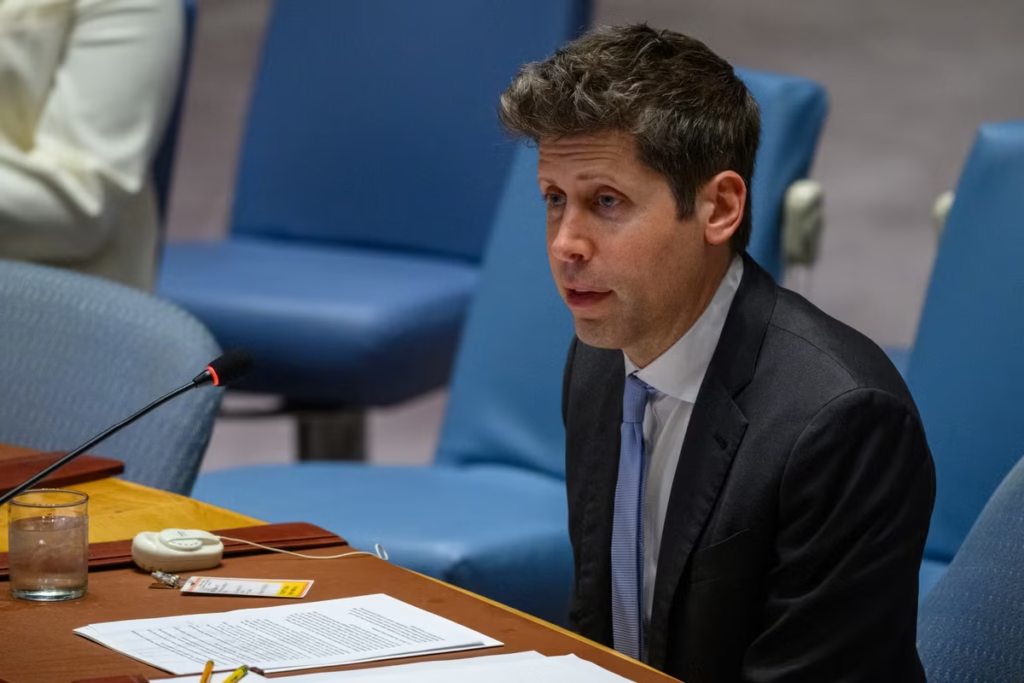
The leaders of three major artificial intelligence companies issued a new warning to the United Nations on Wednesday about how rapidly evolving artificial intelligence models could soon self-improve, evade human control and jeopardize global security.
Speaking before the 15-nation body during the annual sessions of the United Nations General Assembly were OpenAI CEO Sam Altman, Anthropic CEO Dario Amodei and Hugging Face co-founder Clément Delangue, key figures at the forefront of the tech sector.
“If handled poorly, I even believe that AI could pose a risk to humanity as a whole,” Anthropic’s Amodei told the Security Council.
“We may lose control of the future to artificial intelligence,” said Altman, CEO of OpenAI.
As regulators struggle to keep up with the rapid development of artificial intelligence, global authorities remain conflicted. The major powers driving the industry, the United States and China, continue to disagree on whether international regulation is essential or whether market dynamics should dictate the trajectory of the technology.
“If AI is to be democratic, the most important decisions cannot be made just by labs in San Francisco. They must be shaped through democratic processes and by governments accountable to the people they serve,” Altman told the council. “Internationally, this will require cooperation.”
“In our history, there have been times when countries that compete and don’t always like each other very much nevertheless come together for shared interests and the collective good in the face of a powerful new technology. We believe this must be one of those times,” he said.
Yoshua Bengio, a Canadian pioneer recognized as one of the “godfathers of artificial intelligence” and co-chair of the independent international scientific group – created last year by the United Nations General Assembly – told the Security Council: “The dangers are real and imminent.”
“This council faces an unprecedented threat, a threat that none of its members would choose, that no one can contain alone, and that does not respect the borders we defend,” he said.
Speeches were also expected from Council members, including major AI rivals the United States and China. French Foreign Minister Jean-Noël Barrot chaired the meeting.
TRUMP WANTS TO ENCOURAGE AI, NOT PACK IT
Ahead of scheduled talks between US President Donald Trump and Chinese leader Xi Jinping in Washington on Thursday, Washington and Beijing discussed a notification framework for shared risks and objectives, aimed at addressing AI events that reach the threshold of national security threats.
Addressing delegates at the United Nations General Assembly on Tuesday, Trump said he “rejects any attempt to build a globalist scheme to control” artificial intelligence. While he called the progress extraordinary, he noted that the United States would proceed with caution.
“We’re ahead of China and everyone else now, and we’re going to keep it that way,” Trump said. “I will not stifle the growth of something that will be bigger than the Industrial Revolution.”
“We will encourage it, not restrain it. We will watch it closely through the Department of Justice,” he said.
United Nations Secretary-General Antonio Guterres, a longtime advocate of global AI governance, has warned that the rapid advancement of artificial intelligence poses risks that cannot be ignored, putting him at odds with Trump.
The first Security Council discussions on AI-related threats took place in 2023, during which China warned that the innovation must not turn into a “runaway horse,” while the United States warned against using it for censorship or political repression. Subsequent deliberations on artificial intelligence were chaired by then-US Secretary of State Antony Blinken in 2024.